
Third, a Colonizing company building human settlements.
Apollo was exploration. Artemis is the beginning of permanence. What comes after Artemis is industry — and the private development of the first human-crewed bases beyond Earth is the most consequential infrastructure opportunity of the coming century.
The Extraterrestrial Company is backing a company that originates and finances privately owned, human-crewed facilities on the lunar surface, beginning at the south pole. Modeled as Moon, Mars or Asteroid surface industrial hubs: anchored by The Extraterrestrial Company industrial clusters: Mind, Grid, Contact, Transit, Plate, Forge, Soma, Sustenance, and Hearth, integrated with the MineCo operations they support, and designed for permanent human occupancy at working scale.
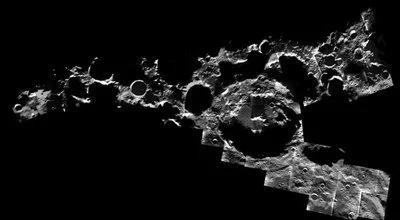
A mosaic of the Moon's south polar region created from images from ESA’s SMART-1 orbiter.
Why the south pole of the Moon?
The lunar south pole is where the deep space economy begins. Three features of the site make it uniquely suited to permanent human and industrial presence. Features that apply to no other location on the Moon.
The Rim of Eternal Light
Along the rim of Shackleton Crater and nearby peaks at the lunar south pole, certain elevated ridges receive near-continuous solar illumination — in some locations, sunlight for more than ninety per cent of the lunar year. This is the Rim of Eternal Light.
The lunar day-night cycle is twenty-nine Earth days. Surviving it has been the primary engineering constraint on all surface operations since Apollo. Solar panels are useless during the fourteen-day lunar night; batteries capable of bridging that gap are prohibitively massive. The Rim of Eternal Light eliminates this constraint. A base sited on these ridges receives near-continuous solar power — supplemented by the fission surface power (FSP) systems we are developing — and can operate continuously, at industrial scale, without the thermal and power interruptions that define every other location on the Moon.
Shackleton Crater and the Permanently Shadowed Regions
Shackleton Crater itself — twenty-one kilometres in diameter, four kilometres deep, its floor never touched by direct sunlight in billions of years — sits immediately below the Rim. Adjacent permanently shadowed regions (PSRs) across the south polar area contain confirmed deposits of water ice, detected by multiple orbital and surface instruments including LCROSS, LRO, and the Chandrayaan-1 M3 spectrometer
Water ice at the base of the ridge is not an amenity. It is the resource that makes everything else viable. Electrolysed into hydrogen and oxygen, it produces cryogenic propellant for the entire cislunar logistics chain — making the south pole a natural refueling hub for missions transiting between Earth and deep space. As liquid water, with appropriate processing, it provides life support for crews and radiation shielding for subsurface habitats. As a feedstock for closed-loop agricultural systems, it enables the caloric independence that defines the transition from outpost to settlement.
Strategic position in the deep space economy
The south pole sits at the intersection of Artemis programme activity, international scientific interest, and commercial resource demand. NASA's Artemis IV and subsequent crewed missions target the south polar region. Multiple Artemis Accords signatories (ESA, JAXA, the Canadian Space Agency, and others) have declared south polar operations as priority activities. The NASA moon base operations provides cislunar access infrastructure that directly supports south polar surface operations.
The Extraterrestrial Company does not compete with this. We build alongside it by developing private BaseCo infrastructure that leverages the government investment already committed, in the same way that private logistics operators leverage public port and airport infrastructure. The public programme de-risks the operating environment. We develop the commercial layer that runs on it.

A composite image using data from NASA’s Moon Mineralogy Mapper. The blue shows areas of confirmed water ice on the lunar surface. ISRO/NASA/JPL-Caltech/Brown University/USGS
Architecture of the BaseCos that we are originating.
Each BaseCo is a private human-crewed facility designed to the operational standards of terrestrial industrial infrastructure in extreme environments — analogous in design philosophy to a deepwater offshore platform or a high-latitude mining station, adapted for the lunar surface environment.
Nuclear and solar power
Dual supply: Nuclear fission reactors providing baseline load, supplemented by high-efficiency solar arrays positioned on the Rim of Eternal Light for near-continuous solar input. Power systems sized for industrial operations, beyond life support alone. The BaseCo is an energy-intensive facility.
Habitat and radiation protection
Subsurface or regolith-shielded primary habitation modules, protecting crews from galactic cosmic radiation and solar particle events in the absence of Earth's magnetosphere. Modular, expandable architecture with airlock systems connecting to surface operations. Designed for rotational crew presence at working scale from initial commissioning.
Life support and resource utilisation
Closed-loop life support systems incorporating water recovery and atmospheric recycling. Water supply sourced locally from permanently shadowed region (PSR) ice extraction, further reducing dependence on Earth resupply and enabling caloric self-sufficiency over time. The transition from consumable-dependent outpost to resource-independent industrial facility is the engineering milestone that defines BaseCo maturity.
Surface mobility and operations
Pressurised rovers for crew traverse to MineCo operations and remote infrastructure sites. Unpressurised utility vehicles for surface maintenance, cargo handling, and construction support. Interconnected surface roads developed in coordination with the Moonport logistics system.
Communications and navigation
Continuous connectivity via the cislunar communications, and the positioning, navigation and timing (PNT) constellations. Zero-latency local area network for base operations. High-bandwidth uplink to Earth for telemetry, crew communications, and data transmission from MineCo and surface science instruments.
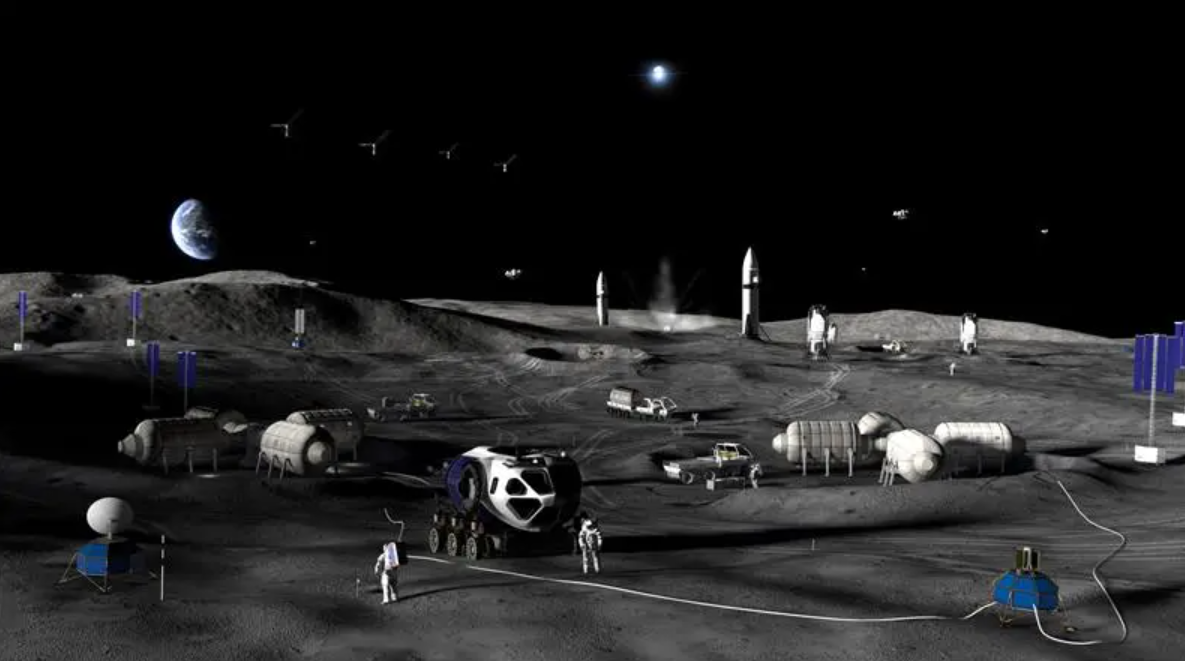
Artist’s concept of Phase 3 of NASA’s moon base by NASA
The Artemis programme and the Moon.
The Artemis programme has changed the context for private human lunar operations in two ways that are structurally important to The Extraterrestrial Company development thesis.
First, it has established the Artemis Accords, which is a framework of norms for responsible lunar operations that now includes over fifty signatory nations. This is not an international treaty, but it is the emerging governance architecture for the lunar economy. The Extraterrestrial Company operates within it, and we believe that the operators who engage constructively with this framework will be best positioned to establish durable resource rights, commercial offtake agreements, and operational access as the governance regime matures.
Second, the Artemis programme is making the capital investments in launch infrastructure, crew systems, and ground support that private BaseCo development cannot justify alone at this stage. MMPACT (Moon-to-Mars Planetary Autonomous Construction Technology), Space Reactor 1 Freedom (SR-1 Freedom), and the Commercial Lunar Payload Services (CLPS) programmes all represent government-funded risk reduction that improves the commercial viability of what we are building. We are building the private Moon bases in parallel with the Artemis programme.