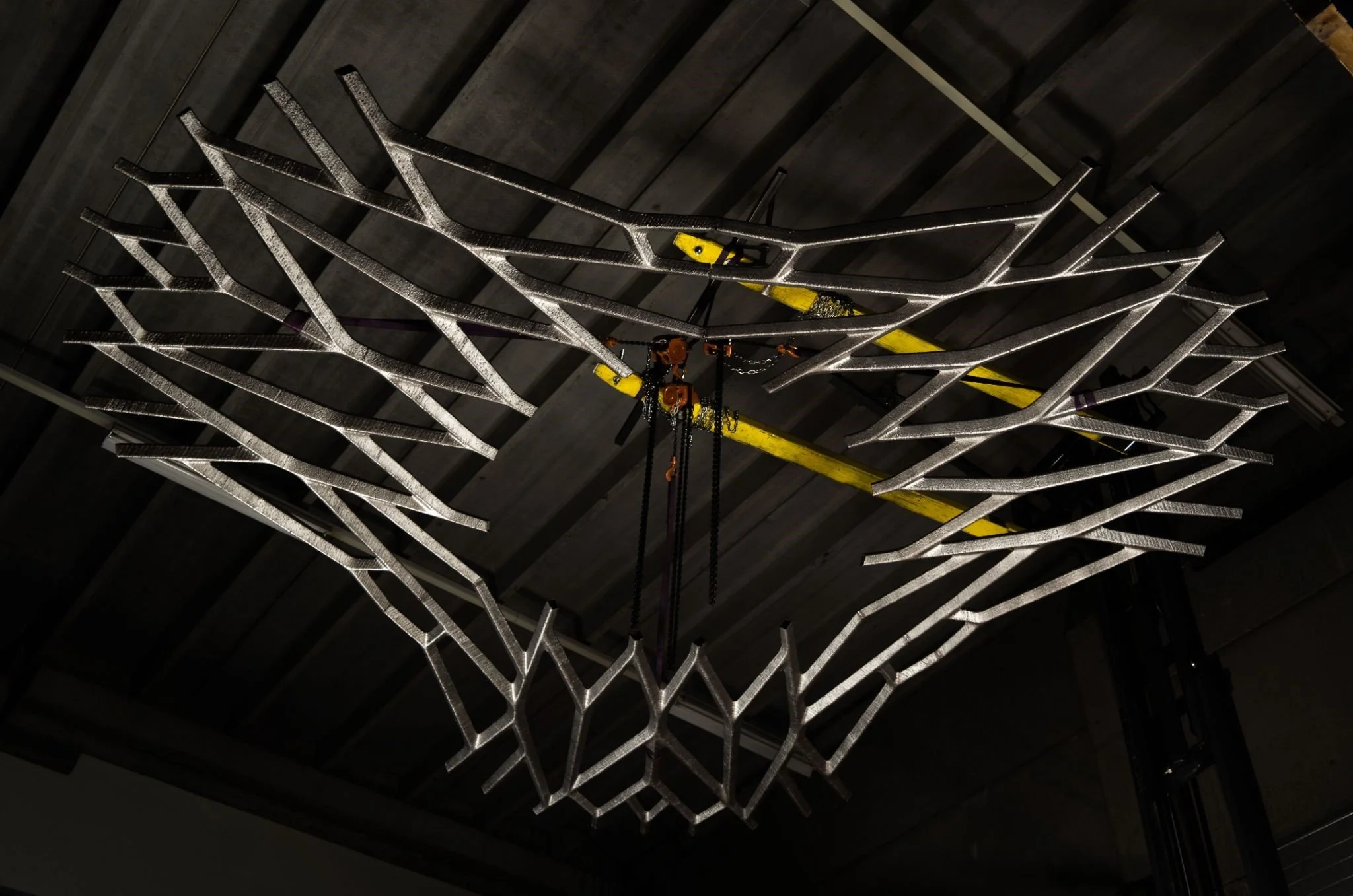
First, we are Industrializing deep space.
Infrastructure precedes everything. Before the first lunar mine can operate, before a human crew can be sustained at the south pole, before space resources can be returned to the Earth at commercial scale, the operating environment must first exist. Power. Data. Communications. Navigation. Logistics.
The Extraterrestrial Company originates infrastructure projects that are this foundational layer. First for the Moon, then Mars, the Asteroid Belt, then on to the broader solar system. We build it as open infrastructure, governed by transparent standards and accessible to every operator in the deep space economy. Our model is based on the modern multi-modal port: open access, commercial terms, scaled to demand.
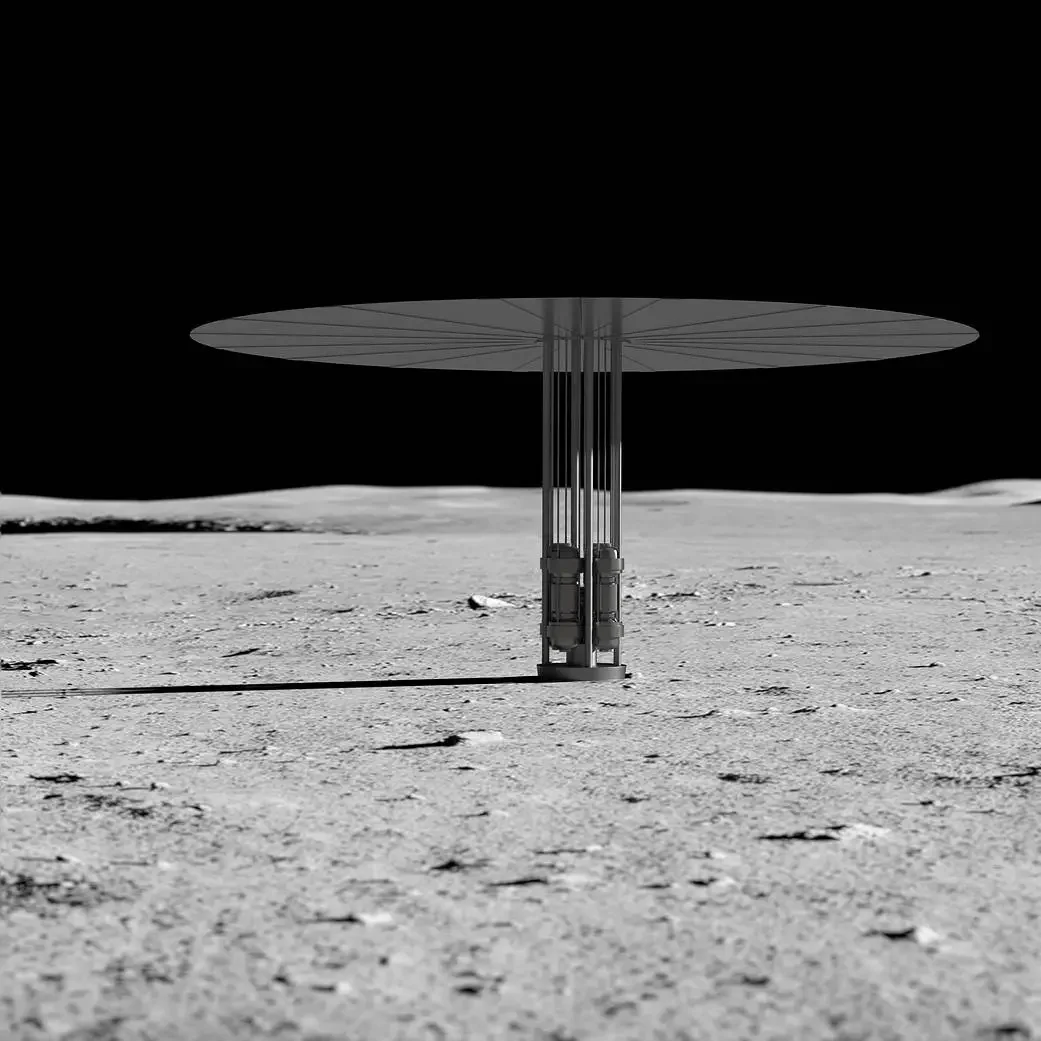
The most recent 1kW space reactor built and tested in New Mexico for DOE and NASA by Space Nuclear Power Corporation (Spacenukes)
Our development mandate extends from geostationary orbit to the heliopause. We begin where commercial demand is earliest and most certain — the lunar surface and cislunar space — and build outward. Each infrastructure element is structured to generate its own returns through long-term offtake agreements and as-a-service contracts, while simultaneously de-risking and enabling the MineCo and BaseCo companies.
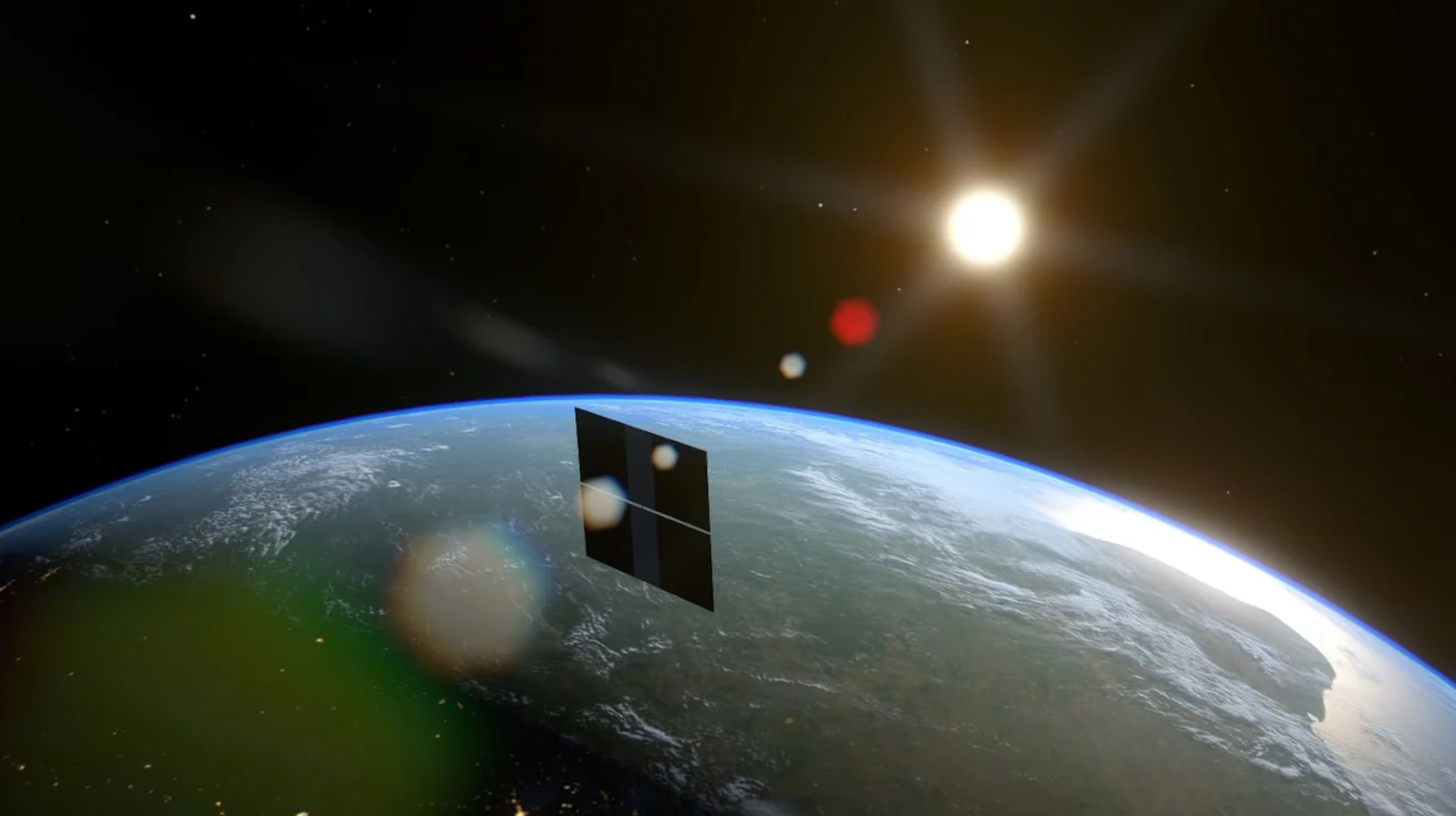
A 5GW concept for a low Earth orbiting data center by Starcloud, one of many to come
Common infrastructure elements for the deep space economy.
The deep space economy requires infrastructure before it requires anything else. Before mining. Before settlement. Before shipbuilding. The Extraterrestrial Company originates, finances, and builds the asset companies that make everything else possible.
Nine layers. Three asset classes. One civilizational stack.
Each infrastructure project is structured as a standalone InfrastructureCo — purpose-built for institutional capital, capable of attracting sleeved financing from sovereign wealth, pension, and reinsurance funds independently. Together, they form the foundation upon which autonomous MineCos and human-crewed BaseCos are built.
Machine Infrastructure, this first phase includes systems that allow machines to work autonomously in deep space.
The Machine Infrastructure assets serve the first generation of deep space operations: robotic and semi-autonomous MineCos operating on the Moon, Mars, near-Earth asteroids, and the outer moons. No human presence required. Full operational autonomy demanded.
Mind, compute, autonomy and edge inference
The cognitive layer. On-surface and orbital data centres, edge sensing and compute nodes, deep space flight computers, and the AI inference stack that autonomous operations depend on. Mind assets underpin every real-time decision made by a robot a light-second from Earth. Structured as compute utilities and as-a-service InfrastructureCos. The intelligence without which nothing in deep space runs.
01
Grid, power generation and distribution
An advanced power grid of power generating assets — stationed on-surface, Moon and Mars orbit and at Lagrange points, providing 24/7 high-capacity power beamed across heliocentric space. Comprised of both nuclear and solar integrated with battery storage and serving mobility, robotics and habitation and life support systems for autonomous mining operations and human-crewed habitation and science.
02
Contact, communications, navigation and timing
The signal layer. A constellation of communications and data relay assets in lunar orbit and at Lagrange points, paired with a dedicated positioning, navigation, and timing network providing the precision on which autonomous robotics, surface logistics, and base management all depend. Structured around offtake agreements with NASA, Artemis Accords signatories, and commercial operators. The lunar equivalent of GPS and broadband — built for a far more demanding environment.
03
Transit, logistics, mobility and surface transport
The connective tissue. Hardened launch and landing pads, blast berms, surface roads and railways, and multimodal logistics depots for repair, recharge, and freight handling. Moonports and Marsports operate as open-access commercial infrastructure — the deep space equivalent of a seaport or airport — serving both robotic MineCos and human BaseCos. Transit assets turn isolated outposts into a functioning economy.
04
Surface Infrastructure, this second phase includes systems that allow machines, and then humans, to build and extract at scale.
The Surface Infrastructure assets extend the stack from operational infrastructure to productive infrastructure. Extraction. Processing. Manufacturing. The systems that transform raw planetary and asteroidal resources into usable materials and components.
Plate, surface construction and site development
The ground layer. Regolith stabilisation, sintered surface construction, excavation and grading, and the civil infrastructure that makes permanent surface operations viable. Plate assets prepare the terrain — for landing pads, for mining sites, for the foundations on which everything else is built. Structured as surface development utilities serving both MineCo extraction operations and BaseCo habitat construction.
05
Forge, in-situ resource utilisation (ISRU) and manufacturing
Hardened launch and landing pads, blast berms, interconnecting lunar surface roads and railways, and multimodal logistics depots for repair, recharge, and freight handling. Moonports and Marsports operate as commercial infrastructure — open access, like a terrestrial seaport or airport — serving both autonomous robotic mining operations and human-crewed bases. The logistical connective tissue of the deep space economy.
06
Human Infrastructure, this third phase includes the systems that allow humans to live, work, and remain in deep space.
The Human Infrastructure assets complete the civilizational stack. They exist to support permanent human presence — in BaseCos initially, and eventually in the permanent settlements that follow. These contain the conditions for human viability beyond Earth.
Soma, life support, medical and human systems
The biological layer. Closed-loop life support systems, atmospheric management, radiation shielding, medical facilities, and the physiological monitoring and intervention systems that keep humans alive and functional in deep space. Structured as life support utilities and health service InfrastructureCos. The minimum viable infrastructure for a human body in a hostile environment.
07
Sustenance, food, water and agricultural systems
The metabolic layer. Closed-loop water recovery and recycling, hydroponic and aeroponic food production, nutrient systems, and the agricultural infrastructure that decouples permanent settlements from Earth resupply. Sustenance assets are the difference between a temporary outpost and a place people can actually live. Structured as utility and food service InfrastructureCos serving BaseCo operators.
08
Hearth, habitat, community and the built environment
The human layer. Modular pressurised habitat systems, communal and social infrastructure, recreational and cultural facilities, and the built environment that makes deep space livable rather than merely survivable. Hearth assets complete the transition from industrial station to human settlement. The last layer in the stack, and the reason the stack exists.
09